Emergency Lights With a Mind of Their Own
Anderson Fleet Service · Kinsman, OH
This ambulance had a fun one. Driving down the road, and the emergency lights would randomly come on by themselves. Nobody touching anything.
Sometimes you don’t know where to start with one of these. There’s so much wiring on a rig, it could be anywhere, anything. But I always start at the switch. The easiest information you’ll get is the voltage at the switch.
Step 1: Start at the switch
Went to the back of the switch. Good 12 volts in. Thought maybe the switch was bad.
It wasn’t.
On the output side of the switch, with the switch off, I had 0.8 of a volt. That’s borderline enough to trip the relay. In my experience, about 1.1 to 1.5 volts will do it.
Step 2: Pull the wire
I disconnected the output wire from the switch and checked the wire end. Still 0.8 volts.
That tells me the switch is off the hook. Power was coming from somewhere in the module, back up that wire to the switch. Not a lot, but enough to almost trip a relay.
Step 3: Hunt for a match
Went to the back and looked at the main board. All the terminals were exposed, so I went across them looking for anything sitting at a similar voltage.
Couldn’t find one.
This truck has a headlight flasher, so I figured maybe something was tied in there. Turned the headlights on and went back to that switch wire.
1.7 volts. Box wasn’t even on, and it was right at the limit.
Now we’re getting somewhere. Something in the headlight or marker light circuit was backfeeding.
Step 4: The marker light that wasn’t just a marker light
This was an AEV. On this one, the marker lights on the top corners of the box also work as emergency flashers. Two jobs, one light. That means the marker circuit and the emergency circuit meet right there in the fixture.
Walked around the box. The right front marker light was out.
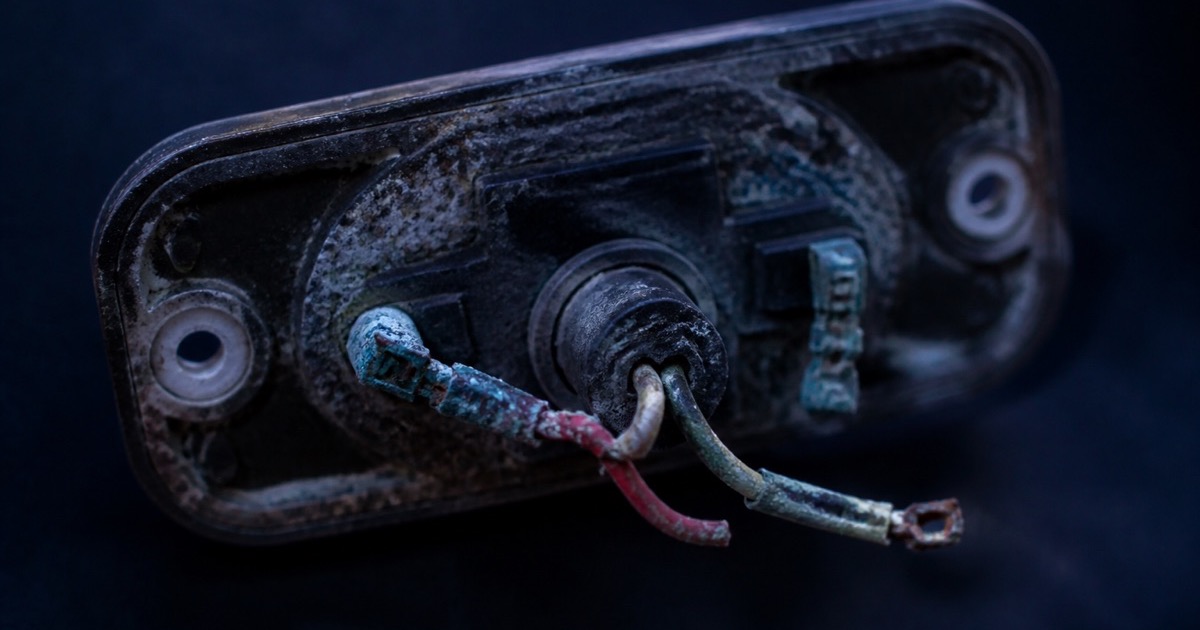
Pulled the light off. Corrosion everywhere, and the wires fell apart when I touched them. Yeah, that’ll do it.
Once that light was disconnected, the voltage on that switch wire went right back down to 0.
So here’s what was happening. Power from the marker light circuit was crossing over through that corroded connection into the emergency light circuit, then backfeeding all the way up to the switch wire. Enough to trip the relay and light up every emergency light on the truck.
Repaired the wiring at that light, and the ghost was gone.
Takeaways from the field
- When it could be anywhere, start at the switch. The voltage there tells you a lot for very little work.
- Check the output with the switch off. You shouldn’t have anything there. Less than a volt can still be a problem.
- Pull the wire off the switch and check again. If the voltage is still on the wire, it’s coming from somewhere else.
- Turn other circuits on and watch the reading. If the voltage jumps, you just found which circuit it’s coming from.
- Know which lights do double duty on that body. Combination lights are where two circuits meet, and corrosion will bridge them.
Final word
Random emergency lights aren’t random. Something is feeding that circuit, and a meter and some patience will find it. If your rig’s lights are coming on when nobody asked them to, give us a call.
More on electrical gremlins: 5 Signs Your Ambulance Has an Electrical Problem and An Electrical Preventive-Maintenance Checklist.
Rig down? Talk to the tech directly.
On-site ambulance electrical, equipment, and eLock work across Ohio and Pennsylvania. You reach Phil, not a call center.